“This Is Your TIme” – Football On A Hot Night In Texas

Highland Park Scots stand for the American national anthem. Highland Park High School, Texas, Friday 7th September 2012
“This is your time. Go get ‘em.
Go on, go get ‘em, this is your time now
This is it, your time, go on now……………………”
What is happening here?
As each player prepares to go on to the field of play a member of the Highland Park Scots coaching staff, a rotund, stocky man, makes a point of saying something inspirational to him. A short, quiet exhortation that implies timing, destiny and honour. These players are boys, seventeen, eighteen years old. Generally they do not acknowledge it but they know where they are and what this is. It’s everything they’ve wanted as far back as they can remember and for some of them these months will be the greatest of their lives. The future is not yet written.
The girls that make up the Highland Park Belles Drill Team are getting something similar from an equally inspirational lady at the side of the pitch. Their faces are locked into a rictus of concentration. Their tights, American Tan to the last, glisten as the final, ethereal hues of the dusk succumb to the interrogatory clarity of the floodlights. This is Texas high school football. Us and them, over and over again. None of it is ambivalent, all of it is vital.
What is happening here?

Highland Park Belles
Highland Park, Texas. It is the first Friday in September and all through the day the external temperature display inside the car has been relentlessly and malevolently defying gravity. It currently reads 108F. The air is torpid, inert and the only sound to be heard outside of the car is the sound of a uniquely American kind. It’s the drone of wealth and it comes in the form of over employed air conditioning units outside of each and every house on the block, reflecting back from the bone white concrete driveways. Across the street a blue and yellow sign is stuck into the lawn of the house there. “Belles Spaghetti Supper. This Friday 5-7pm. HPHS Cafeteria. Catered By Amore.”

Take a spin in the car, if only to turn the dial on the A/C and keep out of the asphyxiative, lacerating furnace of the ambient air. In some other countries it would only ever be possible to experience this atmosphere sitting inside a pine cabin, naked. The grass that lines the front lawns and pavements of Highland Park is that shade of green from 80s teen movies, where 15 year old boys ride bikes in quiet, wide streets looking for Ally Sheedy. Well fed, healthy, comfortable, confident and lush, resting on the hammock of infinitely long hosepipes.
The Highland Park Soda Fountain, one hundred years old, is doing cool and intense business. Nineteen bar stools line the counter. Find one and wait your turn. The Lime Freeze looks like the only game in town, the oasis in the desert. The glass door has a poster on it with head shots of all of this season’s Highland Park Cheerleaders and Scotsmen. These are different to the Belles. The Belles are more acrobatic and perform a show at halftime. The Cheerleaders are pictured in a sort of triangle with a caption underneath that says ‘KEEPING UP THE SPIRIT’. Beneath the Cheerleaders are head shots of the five Scotsmen. Their role is uncertain. There is also a separate shot of them atop the horizontal bar of a football goal. There is a sponsor logo at the bottom of the poster too. Being involved is mandatory here. To not be involved might be a bad thing. Perhaps it would be best to go back and get involved.

The pre-game spaghetti supper is a thousand square feet of systematic and efficient, production line involvement. The five dollar dinner is the fly on the line. The school hall is a grid system of long trestle tables carpeted in auction items, donated by parents, local businesses and other concerned parties. These are not small items. There’s some big ticket stuff here. A week long spa trip to a Colorado desert retreat, a day at the Texas State Capitol as a guest of a member of the House of Representatives, high end loot worth bidding on. The hustle in here is a microcosm of America’s unique ability to be individually entrepreneurial, yet it’s in the service of the group. It’s a sort of American socialism. Over here it might have been called The Big Society, until that initiative died an oxygen starved death from lack of Big Government funding. What drives this though, is the unspoken responsibility placed on the shoulders of all who live in the shadow of the team, the town and the school to be involved. The closeness of the community, in terms of social standing and reputation is highly observed. The Highland Park Scots are the hive and the citizens of the township are the bees bringing in the pollen. What use is an unproductive bee?

Mums sport football jerseys and badges with pictures of the players or the cheerleaders. There’s a queue to have the team logo stencilled on a cheek. ‘Scots’ on one side, ‘Belles’ on the other.
Game time. The opponents are from Monterrey, Mexico which means that the crowd, only halfway full, politely endure the playing of the Mexican national anthem. Three boys in the crowd strip off their shirts to reveal ‘U’, ‘S’ and ‘A’ painted on to their chests in red, white and blue. They are standing in the wrong order though, so it reads ‘AUS’. Someone tuts and points this out. They quickly realign themselves. A Scotsman, standing nearby, apologises for this infliction of overt nationalism.

The boys’ posturing goes wasted. The Mexicans have fielded a lowly fan base for the game, possibly only a crowd of one on their side of the pitch. It’s hard to tell but it may just be a local kid who’s snuck into the away end in a gesture of defiance. He was too high up in the stands to go and ask. Down at one of their corners a lone cop stands watching the action, big gun on his hip. From here, looking across to the home side of the field it’s obvious that the industriousness doesn’t stop when the game starts. A stream of people are filing in, carrying and wearing merchandise from the team shop beneath the stands.

A third of the way through the game and the home side of the stadium is almost full. Most of Highland Park could well be in here. The cops, ambulance and fire officials mingle amongst themselves down in one corner of the field. Along the sideline the players who are not currently on the field of play spend most of the time on their feet watching, exhorting, willing it to go right. The big digital clock on the scoreboard stops and starts in defiance of real life with a regularity that is hypnotic.

Various team coaches draw up plays on portable white boards. They wear the uniform of white, middle America: khakis, white polo shirts, sneakers. They are gruff, confident and look like they get to eat well for it. The relevant team members fan around them and give the impression of listening intently. They look like they are really listening. Head coach, Randy Allen, wearing a shirt, tie and panama hat paces the line with a clipboard in hand, pen in his shirt pocket. Coach Allen signs off all his emails ‘Go Scots!’

The players fit all the stereotypes. Nothing is missing. Have these kids actually evolved to be mirror images of the characters in every high school and college movie ever – Grease, Animal House, Revenge Of The Nerds, Porkies, American Pie – or were they always like this? One kid is so like the quintessential changing room towel flicker, so like Biff Tannen, that he is scarcely believable as a fictional character, let alone an actual real life flesh and blood one standing here tonight. He must weigh 280 pounds and his knees look wrecked already.
The Scots put the pressure on and Monterrey quickly fall behind. The lead is too comfortable. The cheerleaders, sitting it out on the side are a line of ponytailed princesses, banded up high and tight, teen imprints of their mothers, checking their Facebook pages on their iPhones. The band, sitting in the bleachers, strike up. The band leader, an earnest girl in white cotton gloves on a podium at the front, fixes her eyes absolutely on the musicians as her arms strain. Every muscle in her arms gives rise to the belief that in her head she is trying to control an excitable muscular dog on a tight leash.

My host leans in to my ear, “You know, John Hinckley, who tried to assassinate President Reagan, is an alumni of this establishment.”
This is a micro society maintaining it’s place in the order of things. The support system that holds the team up and generates the resources for it to be viable is self determination at work. It is competitive on every level you can possibly imagine, within itself, as well as in its attitudes to those it is up against. It’s uniquely American, it’s how individuals bring their express individual attributes to the situation and leverage them for the benefit of the team, the school and the town, as well as their own personal standing within those places. To not commit in the fullest way would indeed be a bad thing.

The band, maybe forty strong and not big in the context of Texas high school football teams, come on for their role in the halftime show. It’s time for their big idea. My host drops a hint.
“They have been waking me up every morning at 5.55am all summer with their rehearsal of ‘Kashmir’ by Led Zeppelin. It’s pretty damn sweet.”
What follows is deeper and wider than ‘Kashmir’ though, because it is actually a mashup of ‘Kashmir’ and the music of Benjamin Britten. It is truly imaginative, clever and entertaining. This is what I mean when I say it is competitive on every level. Even the band have got serious game. They’re not just here to give the kids who can’t run a chance to be included. They kill it with some outrageous sizzle. Weeks and weeks of motivating sixteen year old kids to rise in the summer dawn and go out on to a barely cooled patch of redundant car park tarmac to go through the mad idea of a faraway, dead English composer mixed in with a long defunct English rock band, over and over again. For the excellence of the group, so they can be better than the other lot, who in this case haven’t even brought a band with them. Us and them, over and over again. This is not just about winning on the field. This is about self, self regard, the group, motivation, pride, relationships, reliability, honour, work and just being really, really good at the thing they’ve chosen.
Year in, year out, a place like this, a scene like this is where America renews itself. This is what’s happening here.

Post game prayer

Clyde Biggins: The Legend Of BBQ
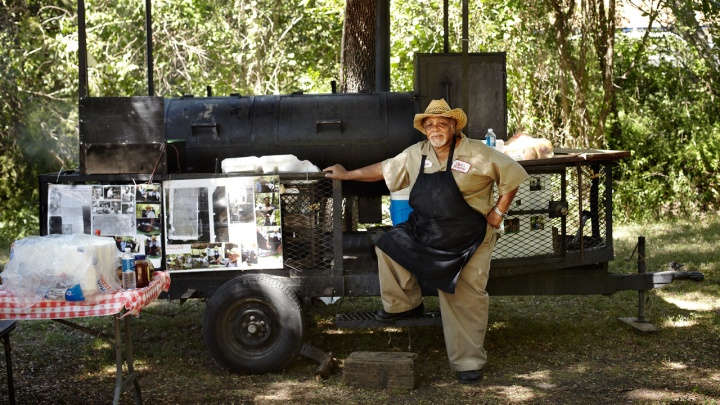
Clyde Biggins. Dallas, Texas, September 8th 2012
I was down in Dallas in September 2012 to photograph a story on high school football and was staying with an old friend who lives there. He and I both like to take the opportunity to enjoy high quality meats whenever the chance presents itself. The American South, of course, is the place to explore what the meats are capable of giving when cooked on a barbecue pit. Each state has its own methods and techniques and, I’m sure, if you want to get really picky you can find those who believe it varies dramatically from county to county too.
A few days before my arrival, my friend, Trent, sent me an email with a link to a post on the Texas BBQ Posse blog, strap line, “In search of the greatest smoked meats in the greatest state in the union.”
Gary Jacobson, who wrote the post, began by explaining that he had recently been the recipient of a letter from a man by the name of Clyde Biggins. Clyde claimed that he had once been the owner of “Clyde’s Old Fashion Hickory Smoked Barbecue” on Westmoreland Road in Dallas.
In 1993 he had been convicted for his part in a conspiracy involving illegal drugs, was convicted and now almost at the end of an eighteen year term in a federal prison.
The piece went on to explain how Clyde was looking to get back on his feet when released and could the members of the Posse do anything to help in that regard. You can read the full text at the link below. It’s a great read and is a story that contains the mouth watering seeds of the possibilities of redemption.
http://texasbbqposse.blogspot.co.uk/2012/06/clyde-is-back-cooking-some-of-best-bbq.html
To cut a long story short, Clyde has been unable to secure the food licences that would allow him to once again set up shop in Texas. To get around this he has put together a mobile rolling barbecue and positioned it in his front yard. Food is free but diners are encouraged to leave a tip. He invited the Posse over to try his cooking and Posse member Jim Rossman revealed, “Clyde’s the real deal. The meal I had would easily rank him in the top 5 among Dallas-Fort Worth BBQ joints, plus he has a great personality. That’s a winning combination.”
“Watching Clyde work that pit was like watching a great conductor lead a symphony,” Posse co-founder Chris Wilkins said. “No thermometers, gauges or gimmicks. It was old school cooking by feel alone.”
Clyde was reluctant to allow the members of the Posse to reveal his address on their blog, for fear of being shut down by local officials, despite the fact that two Dallas cops stopped by that afternoon to pick up some takeaway, so there was no way to locate him.
After reading the story I sent back a reply to Trent: “Your mission? Find Clyde.”
In the lead up to my arrival Trent reported back regularly with the news. No dice every time. All through my stay the backdrop to the hundred and five degree heat was the hunt for Clyde. Still nothing until, on my last full day in Dallas, Clyde joined Facebook. Trent sent him a message with his phone number and within five minutes Clyde had called back with an invite to come on over and “sample some meats”.
I didn’t go over there with the intention of doing any filming but I took my camera anyway, mainly in case I got the chance to do a portrait of him or something. When we got there, the mid afternoon sun was beating down but in the shade of some big, heavy trees everything just seemed so much more mellow and amenable. We sat down on some chairs in front of his pit while the smell of pecan smoked meats drifted on around and he was more than happy to tell us his story. So, I had to use what I had and I shot this short handheld with one 8gb memory card and interviewed him with the voice memo app on my iPhone. Someday I’d like to go back there with a jib, a dolly and a crew worthy of the subject.
If you’re ever in the Dallas area make sure you take some time out to find Clyde. He really is the real deal. In the meantime, this short film might give you a flavour of how good his food tastes.
The Way I Dress: Mr Santa Claus
As the public face of an iconic brand, Mr Santa Claus needs to send a consistent visual message to potential customers. In this exclusive interview he allows us a glimpse of the extraordinary wardrobe he keeps in his contemporary home, reveals that he believes he works in the creative industries, rather than the retail sector, and shows off a previously unseen tattoo.
Mr Claus made his name with his pioneering business model, which sees his organisation give away a vast number of children’s gifts each year, to publicise its bestselling range of Christmas merchandise. Between his ranges of cards, sweets, toys and decorations, not to mention the licensing of his image for adverts, and his employment agency, which supplies stores all over the world with look-a-likes, Mr Claus’ trademark appearance is big business. No wonder he puts so much time, and investment, into his remarkable visual identity.
Asked during filming about his plans for 2013 Mr Claus mentioned the fortnight he takes each January to recover from the Christmas rush – he likes the Amandari hotel in Bali – and the annual February awayday he organises for his team to brainstorm ideas for the year ahead. However, Mr Claus wouldn’t comment on recent speculation in the financial press that he’s considering taking on the confectionary industry with a new Easter project, although his reticence may be due to his recent run-in with the regulatory authorities over monopoly issues.
Directed by Chris Floyd
Art Direction by Jacopo ‘Jay’ Maria Cinti
Text by Mansel Fletcher
Bedroom Eyes: A Short Film About Eyelashes

Back in the summer, when the days were all that stood between us and the horizon, the pollen lingered wistfully in the beams that sliced through the blinds and the ringing of the schoolyard bell was still far enough away to echo only momentarily before drifting and dying in the buzz of the lawnmowers outside, a group of us stood in a languid London bedroom to make a short film about eyelashes.
Nina and Max the founders of London make-up brand, Eyeko, had asked Kay Montano and I to create something for them that would allow people to see just how good their products are. As well as being a great friend, Kay is one of the finest make-up artists in the whole wide world.
We all stood in that bedroom and as the afternoon light gathered about us I turned to Kay, nodded at our model, Jess, and said, “Only one road to go down on a day like today, with a girl like that, in a room like this. It’s got to be Marilyn.”

‘Marilyn in Bed’ at the Bel Air Hotel by Bert Stern, 1962.
No one really needed to say much more. As Kay put it herself on her blog, “we trusted in the osmosis of a lifetime of iconic films and beauty icons in the forefront of our nerdy minds to guide us.”
The music is ‘Again’ by Tamara Schlesinger and was suggested by my ever patient editor, Dani Jacobs. Having Dani on my side is one reason why I love making films. The opportunities to collaborate and allow others to add value are endless, as long as you are prepared to leave your ego at the door and welcome them in to the process as equals.
The Way I Dress: Mr Joshua Kissi
Straight out of The Bronx, New York, Joshua Kissi, who can often be found on Instagram posting up his late night bike rides through the city that never sleeps, is one half of influential style blog, Street Etiquette. On the subject of to roll or not roll up his trousers he says, ” I roll up everything, some people make fun of it, some people don’t like it but, hey, it’s your personal taste.” And his personal style, “Sometimes Afro-dandyism, sometimes mod, sometimes punk, a touch of prep, a touch Americana, colours, patterns, silhouettes, jewellery…….it’s an amalgamation of everything I’m interested in. My style is just style. I wouldn’t put it in a category.”
Filmed om location in Brooklyn, New York, September 2012
Several Studies In Charlie Brooker

Charlie Brooker, London, 12th June 2012
Here’s an email I received quite late on a Friday afternoon in April of 2012.
“Hi Chris,
My name is Luke, I’m a designer at Faber & Faber. One of our co-publishers at the Guardian gave me your details, and after viewing your website I felt compelled to get in touch. I see you did Caitlin Moran’s book recently, which most publisher’s design teams are pretty jealous of.
We commission a fair bit of photography, of both high and low profile people for use on our book covers. I’d love to meet you and see a bit more of your work – would you be up for either coming in to see us and showing us your portfolio, or meeting for a coffee somewhere convenient for us both in London?
Best,
Luke”
Of course, being utterly incapable of playing hard to get, I immediately replied to Luke and made an appointment to go in and see him at Faber in Bloomsbury Square, London.
There is a whole dilemma at work for a photographer in this age, when it comes to how to show one’s work to a new/prospective client. Print portfolio, or iPad? IPad, or print portfolio?
The reality is that I like to use both. The iPad makes EVERYTHING look better. It is slicker, less fumbly, less clumsy. It can make almost anything look good, which is why you should take a print book with you to prove that your work stands up by itself without the support pants and corset of that HD super glossy screen. I’m doing films and moving image work more and more now. Even if the person I’m going to see is not commissioning me for those things it’s still nice to be able to show them some of that if they are interested.

We are, these days, selling ourselves as a brand as much as any other. I don’t particularly enjoy that and it distresses me that I have to think like that but, then again, I don’t really know much about televisions either, so if you stuck me in a roomful of them I’d probably shrug my shoulders and point at the one that says ‘Sony’. It’s a trusted brand, the trust built up over decades through product excellence and diligent, brilliant marketing. Same with photographers. Some (NOT ALL) of the people who commission photography don’t really know much about photography. They always go for the big brand names. They know that no one will laugh at them and other people will think they’re really cool. There are photographers out there who would do the job just as well, maybe even better and also for less cost, but, well, you know how it goes. Those big names have earned their place by proving themselves early on but they’ve stayed there by turning themselves into brand names within our industry just as Sony, Mercedes, Apple and Gaggia have in theirs.
Fifteen years ago someone said to me, “You know, when someone hires you, what they’re really paying all that money for is your opinion, your visual opinion. You’ve demonstrated that the way you see things has a validity to it and they want you to do that for whatever it is they’re trying to sell. The most important thing you can do is maintain the integrity of that opinion by making sure that you don’t do anything that might compromise the way people interpret it.” The more time passes, the more that statement resonates.
I have never been able to actively go out and sell myself. I mean, I can do it a little bit but it’s not my default state. In the main, I have always tried to just do the best work I can and hope that the people I want to work for will see it and then look for a reason to want to work with me. Being brand aware means being so much more conscious of treading an almost fascist path through one’s career. It means actively pursuing a course, rather than being satisfied with where the wind takes you. I’ve developed a technique, twenty years into my career, that embraces a mix of each. I will spend six months carving a particular path and then I’ll turn the engine off and let the wind take it from there for a while. I try and plant seeds that will bear fruit later. Plant them regularly so that, hopefully, I build up the possibility of regular harvests. It’s the method I’ve developed that best allows me to pursue my ultimate aim, which is longevity. I put this down to the fact that I never had any formal schooling in the politics of the business. I never learned from anyone how to play the game and sometimes I lament that because this is an industry that does contain a lot of game players, people who for whatever reason are not necessarily particularly self confident or secure and who mask this by applying layers of deflective materials to their outer shell.
When I started writing this post I wasn’t really sure where I was going with it but now I do. The seed planting analogy goes all the way back to Luke’s mention of the Caitlin Moran book cover. In this post from August 2011 I wrote about how that picture came to exist and the consequences of it. This email from Luke is a good example of that seed bearing fruit two years later.
I thought hard about the format in which Luke might like to view my work and I decided that he seemed like the kind of guy that would get a kick out of having a look at a big old fashioned print book, what with him being part of an outfit that has for many decades been in the business of producing works in print. However, on the day of our meeting both my print books were otherwise occupied. All that brow furrowing was for nothing. I went with the iPad.
At the meeting I went through some of my work, we watched one of my short films and he quickly came to the point, which was nothing other than a lively surprise. I thought that he just wanted to meet me, leaf through the work and keep me in mind for things in the future. That’s what usually happens. In this case, though, there was a specific project on the immediate horizon.
Faber, in partnership with The Guardian, were planning to reissue three of Charlie Brooker’s recent books with new covers, alongside a brand new hardback, entitled ‘I Can Make You Hate’. Would I be interested in working with Mr Brooker on producing the covers for 4 books? Yes I would. ‘Hate’, as we came to refer to it was a thinly veiled parody of a couple of books by a well known television hypnotist and self improvement guru. Luke’s idea was for the cover to parody the self improvement guru’s book covers, with a smug faced Brooker in his place. The three reissues were to be a photographic representaion of the illustrated covers that the books had previously had. Luke sent me some extremely detailed and finely tooled illustrated briefs to work with.

Luke Bird’s Storyboards
There is generally not a cascading waterfall of money available to the people that create the cover art in the book publishing industry, so, in lieu of hiring a studio, we were offered the use of the Faber boardroom to do the shoot in. The boardroom still contains TS Eliot’s chair. How can you turn that down?
On 12th June Luke from Faber, two assistants and I carted all our equipment, lighting and backdrops through the narrow front door of the building and up to the well proportioned boardroom that overlooks the British Museum. Luke had done a great job of sourcing some good props and had also spent the previous weekend hand making a brilliant cut out of a red and yellow hellish inferno for use on ‘The Hell Of It All’ cover.

The thought of actually meeting Charlie was daunting. I rarely get intimidated at the prospect of having to work with someone but in his case the power, wit and imagination of his writing and personality were starting to make me think that he was not going to want to spend much time on this frivolous and self evidently vain crap. I couldn’t have been more wrong. Over the course of the day we shot about 900 pictures and when I look through them I’m reminded how much effort and thought he put into the process.

Rather than play the part of a passive and parodically curmudgeonly author, he gleefully embraced the collaborative process and delivered a genuinely wide portfolio of options, especially when it was time to turn his attention to the ‘I Can Make You Hate’ cover.

Jobs like this, it can be easy to get lost fulfilling the brief. As the day wears on I try to keep it in mind to do something for myself, to do a picture that I would have done without a brief. It’s not a separate thing that I try to do but more of a way of working where I keep my eyes open looking for the thing that I’m looking for. It’s not a tangible thing, it’s a subjective, esoteric thing. At a point, late in the day, it presented itself and it’s the picture that heads this post.
Why is it that one? Writing this now, I haven’t looked at the picture since I finished working on it but it’s clear in my head. I can see it quite precisely. It represents the way I saw Charlie that day. He’s a unique writer. He’s carved his own niche. The reason I think it resonates is because it casts him in a light that shows him as a man who highlights things, often dark things, particularly in the TV drama he’s creating now, that we didn’t necessarily realise we were aware of until he wrote it.
Someone I know suggested that he’s Jeremy Clarkson for Guardian readers, which I do think is a pretty funny and insightful observation. But it also possibly says more about the way the people they work for pitch both men at their audiences.
The theme that I think exists throughout much of his work is a projection into the dystopian near future. In this light, the person that he most reminds me of isn’t Paul McKenna, it’s JG Ballard.

The Way I Dress: Mr Nick Sullivan
Mr Nick Sullivan is the fashion director of US Esquire. He was born in Dorset, England, but is now based in New York City. “I think I probably picked up a few things about style from my dad, and I’m slightly inspired, in a way, by photographs of him from before I was even born.” On the difference between fashion and style, “There are two camps, one worships fashion and the other worships style. To me the difference is less important than what they add to each other.”
The film was shot in his house in Brooklyn, New York and the music for this new series is by my very best New York friend, Mr Jason Darling, who I first met in a bar in London’s Soho, way back in 1998. Finally, we get to collaborate.
Rule Britannia

Laura Trott, Spring Studios, London. 11th August 2012
On Wednesday 8th August 2012 I was on holiday, staying in a rented cottage, down in the New Forest, a place of childhood memories, one of my favourite places in the world. The phone signal in the cottage was non existent but there was a wireless connection in the pub over the road. I’d got into the habit of wandering over there a few times a day, like the typically connection addicted citizen I am, to check my emails. Truth be told it was also an opportunity to get away from the tyranny of spending every minute of the day with my 2 small children, an escape from the incessant noise and brain mashing claustrophobia of it all, to enjoy a quiet 20 minutes alone in the company of half a cider and the Olympics on the pub’s megatron HD telly. A day earlier I’d sat in there and watched 20 year old Laura Trott win a fabulous gold medal in the women’s omnium event in the cycling.
On my final swerve of the day I went out the door and over the road about 10pm. An email plopped into my inbox from Monica Allende, picture editor at The Sunday Times Magazine.
“What are you up to on Friday? Trying to put a v. last minute shoot together and checking your availability.”
It was clearly urgent but there’s two kinds of urgent. There’s the urgent that can make this job the best thing in the world, where all the cards fall into place at the perfect moment, where you get to meet and have an intense one to one with someone brilliant or world changing. Then there’s the other urgent. The other urgent is the one that is brought about by a relentlessly negative chain of events. They wanted somebody else for the job, the subject changed the date, the chosen photographer couldn’t do the new date, a better story has fallen through and they need something to fill the gap. It’s the urgent that’s brought about by a series of failures. Your role in it, if not handled carefully, could forever associate you with those failures, despite the fact that you were not even involved at the point that they took place. No matter how good a job you may do you will always be thought of as the person to call when the person they want is not available. Best to try and avoid those if you can.
Aside from the perception of urgency generated by Monica’s email, Friday was also the last full day of our idyllic week in Hampshire. We were planning to hand back the keys to the cottage around 11am and go a few miles along the coast to see some friends who have a boat, where we would spend the day with them, messing about in the Solent and even, perhaps, make land at the Isle of Wight for an ice cream before heading back to the mainland for the drive home to London and it’s strange McEwanesque August atmosphere.

The Idyllic Cottage
I mulled it over for about 10 minutes before hitting the ‘reply’ button. Stay here and enjoy the last day of a truly memorable and classic English holiday, with the promise of a jump into the Solent off the side of a boat? Or take the risk with a different kind of leap that this was the right kind of urgent? I tapped the reply button on my phone and typed a response to Monica.
“I am totally around. What’s the job?”
I stayed in the pub for about half an hour but she never replied.
The next morning, though, everything started to happen. Monica emailed around 11.30am and came clean with the facts.
“The idea was to shoot Laura Trott as Britannia for the STM Olympics special. It was almost confirmed last night, but she is a bit freaked out this morning after all the media coverage. I won’t know for an hour but even if they confirm I am not sure we can put such a demanding shoot together. See attached the idea I have in mind. If it was to happen tomorrow afternoon I would still like to meet in the morning to prepare it all , but as we stand I haven’t got a team in place yet.
How do you see it?”
These screen grabs were attached to her email, which were a great help in making me realise a) how we should do it and b) how we should not do it.

Immediately I knew how it had to look and how it could be done. It was actually pretty simple. I replied to Monica.
“I thought it might be something Olympic! It can be done. As long as we have Laura, a studio and the props/clothes it is totally possible. As with anything else like this, the key to it is to make it modern and stylish, otherwise there’s a danger of it looking naff and cheesy. The way to do it is to keep it extremely simple. The lion might be a problem though.
Other than that I am confident it can be done.”
In any photographic situation where there is a danger that it might go all wrong, where the execution can be way too literal, I always try to steer it back towards the one element that is the most important: spirit. In this case, Laura Trott is a 20 year old girl from Hertfordshire. A week earlier no one, including me, outside of the world of track cycling had heard of her. In seven days she, among several others, had come to embody an ideal of how we would like our country to be. Hard working, modest, humorous, good at stuff and very much alive. Binding her up with spears, shields, togas and chariots would drag her down more than anything. How to make it work?
I close my eyes and I think of the canon. The canon are the photographers I draw on in times of doubt. They give me comfort, solace and inspiration. They include Richard Avedon, Helmut Newton, Bruce Weber, Lee Friedlander, Sally Mann, Corrine Day, Glen Luchford, Erwin Blumenfeld, Harry Callahan and, in this case, Irving Penn. I close my eyes and I go through the rolodex in my head thinking of them all until I find the one that instinctively feels like the inspirational match for the task at hand. That’s not to say I set about slavishly ripping them off. I use them as my starting point, my jumping off point. They are my photographic moral compass. They show me the light, guide the way and keep me company. Once I push off and get underway I’m then going forward under my own steam. By the time I get to the other side I will have, hopefully, added enough of my own ingredients to the dish for it to taste new and different. To understand what I mean then check this out:
Bad Penny Blues by Humphrey Lyttleton (1956).
then this:
Lady Madonna by The Beatles (1968).
Each of them are great but one was a jumping off point for the other. I love it. You can hear the lineage right there.
Anyway, back to Irving Penn. It took me about 0.5 seconds to ask myself ‘What would Irving Penn do?’ It just seemed so obvious. I called Monica up and we had a great talk about what to do. I said this is an Irving Penn picture. She replied that they wanted the backdrop behind her to be a Union Flag but the flag, she thought, should be very faded, as if it has been hanging out in the wind for 50 years. I agreed totally but there was no way we would be able to find a flag big enough with one day’s notice that is also the right texture. It would need to be about 30 feet by 20 feet big. Going back to my earlier mention of instinctively knowing how we should/should not do it. I want to hint at Britannia, not hammer her into the role. The Union Jack is the main element. Then maybe the shield. Definitely not the helmet. Please God not the helmet. Besides, she has those plaits that have instantly become her trademark. It must be a modern picture but with nothing brash or shiny about it. No forced heroism or shot from below constructivist nonsense with added clip lights. It should be elegant, chic, classic and classical. I want to do it like that but with the help of a little bit of modern technology.
What did I mean by ‘modern technology’?
This was the part where I would have to convince her.
“Ok. We’ll get a big canvas, battered, old, frayed, worn, grey, grim. I know where we can get one of those. We shoot her on that and then we add the Union Jack in afterwards with CGI.”
I had tried something like this a couple of years ago on a shoot I’d done with N-Dubz, Tinchy Stryder, Chipmunk & Taio Cruz. That one had been shot on a white studio cove and I had used CGI to add in a monochromatic Union Flag afterwards. Three years further on, though, I thought that both the technology and skills of the person I had in mind to do it would have advanced enough to be able to make the flag look not only convincing but properly fantastic. Having this earlier example to show Monica was helpful in convincing that this was a way better option than trying to project a Union Jack on to a backcloth. All I had to do was explain that this was shot on a flat white/grey background and the flag was constructed digitally. What you do with that flag is entirely subjective. If we took that idea and put it onto a canvas, a fabric with motion and life in it, rather than a dead wall, then we could make it work so much better.

N-Dubz, Chipmunk, Tinchy Stryder, Taio Cruz. London 2009
At some point on the Thursday it was decided that Friday was just too short notice and Laura was persuaded to make the trip to the studio on Saturday instead. This meant that I got to have that last full day of holiday and we did indeed spend a gorgeous day on a boat bobbing around the Solent.

Somewhere in The Solent. Friday August 10th 2012.
My time at sea was periodically interrupted by emails from Georgia Lacey, the prop stylist, with questions about Britannia related matters, the best one being:
“Morning Chris. Do you have any preference on spear?”

Call time for crew was 7am at Spring Studios in Kentish Town, London, on Saturday 11th August, four days after Laura had won her second gold medal and three full days after the shoot had first been proposed to Laura. Having worked for magazines for almost 20 years, I had never known a shoot or story come together so fast and at such short notice. Laura was due to arrive at 9am and we would have her for two hours. One hour would be taken up with hair and make up, so that would mean an hour of shooting time. In theory that is plenty but we had also agreed to try the shot in several different ways, with variations on props, hair and medals. I have always felt that less is more ever since I heard Michael Caine tell a story about how director John Huston told him “Do less Michael, do less. I can see you acting.” However, Monica thought it important to give the art director at the magazine plenty of options. We had several Britannia style shields to hand but Monica had the best idea of all; to use a wheel from Laura’s bike.

The first thing for my assistants to do was get the canvas backdrop up. Much of Penn’s greatest portraiture was done using natural light. I couldn’t do that here, the studio’s daylight source was in the wrong place and it’s just not strong enough to give me what I wanted. I set about trying to replicate Penn style daylight with artificial lights. I do this by building a replica window from 12 foot by 4 ft polystyrene flats (polyboards) – which forms a three sided room with the open side bound by layers and layers of thick diffusion material. I use all sorts of things – silks, rolls of spun glass, trace, plastic bags, anything that impedes the light from travelling in a straight line. The lights then go inside that room and the diffusion hopefully acts in the same way that thick cloud does on the sun.

Canvas going up. Lighting and diffusion on right.
We shoot a lot of test pictures and I can get incredibly fussy about whether or not light looks right. To me it either looks right or it looks fake, it just looks wrong. Sometimes the journey there is quick and everything falls into place and other times it seems to take forever, with detours and wrong turns but when it feels right it just, well, feels right.
By the time Laura arrived we were pretty much ready. I was genuinely moved to meet someone who had done something so special at such a young age and, whatsmore, who really did seem to wear it so well. I asked her who had presented her with her medals.
“I dunno really. Just a couple of randomers.”

Double Gold Toes

Once she came out of hair and make up (incredible job by Hamilton Stansfield) and through wardrobe I could tell that all Monica’s worries about not pulling this off were just that, worries. Everyone had done their part perfectly. All we needed now was to get the right shot. And after trying several permutations of prop and pose we settled on this. The movement in the canvas was provided by my 2 assistants, Andras & Phil, rippling it from each side.
Once Monica had selected the image it was sent over to Rick Carter at Paperhat FTP who put Lee Rouse to work on creating a Union Flag from the blank canvas behind her. We had to provide him with a whole slew of measurements from the lens to different points in the shot so that the computer could work out angles and plot points that would allow it to overlay the image of the flag on to the ripples and folds of the blank canvas. He spent all of Saturday night working on it. By lunchtime on Sunday the finished image at the top of this post was completed and sent to The Sunday Times. They had held back printing for four days to accommodate this as the cover of their Olympics special issue, which is out today, seven days later.

Laura Trott, Spring Studios, London. 11th August 2012.
So, after all that, why do I feel this is right? The right way to have done it, not the wrong way. I’ve said before that twenty years of experience adds up to a lot of mistakes. These come back to you in the form of wisdom. This doesn’t mean that you become complacent though. As I’ve got older I’ve realised that the only way to not become complacent is to stay paranoid.
It’s all there. It feels true, even though it’s a constructed image. It has honesty at it’s core. The colours, the tones of her skin, the strength, the quiet confidence, ready but not offensively aggressive, not an ounce of empty bombast. Who wouldn’t want her on their side? She should be on town hall walls all over the country.
It has the one ingredient I mentioned at the start of the process. It has spirit.
With about ten minutes left before she was due to leave, I took her over to a separate set up we’d prepared earlier and took a portrait of her as herself. We barely spoke. I didn’t need to say anything. Everything she is was right there in her face.

Laura Trott, Spring Studios, London. 11th August 2012.
The Four Minute Mile Stopwatch

One of three stopwatches used to record the time of Roger Bannister’s sub-4 minute mile on the 6th May 1954.
Last year I was commissioned by ESPN Magazine in New York to go to Iffley Road sports ground at the University of Oxford, where, in a glass case, is the stopwatch that was used to record the time of Roger Bannister’s record breaking mile on the 6th May 1954. This was the first time the mile had been run under four minutes.
ESPN were preparing a photographic feature on great pieces of sporting memorabilia and my shoot with the watch was one of many others they had arranged.
There were actually three watches used that day, in the event of a breakdown or doubt. You could call it belt, braces and glue. The other two are now in private hands and this one is still the property of the club. The other interesting thing about the watches is that they are 30 seconds to a revolution, so the hand had to travel just short of eight complete circuits to do it’s job that day.
In the excitement, joy and pandemonium immediately after the race the watch was knocked from the timekeeper’s hands and the glass on the front cracked on impact. Part of it is forever missing and you can see that in the picture above. Bannister’s record breaking time is preserved though – 3 minutes 59.4 seconds.
The club secretary took the key to the glass cabinet that the stopwatch lives in out of his desk drawer, unlocked the door and handed the watch over to me. History in my hands, reassuringly heavy too, a wonderful thing. I set up my lighting and table top backdrop in an empty squash court and spent a lovely afternoon messing about with light, shadows and time.
After the story ran I was asked by the magazine’s then photo editor, Catriona Ni Aolain, if I could make a large print of it for the editor in chief. Of all the items they had photographed for the story, this was the one he wanted to hang framed in his office.
Seven Days With Sebastian Coe

Seb Coe making his case to members of the Greater London Authority in a portakabin at the Olympic Stadium site, 2008. Note the detailed diagram beside him.
Now seems like a good time to post these pictures. Tonight is the opening ceremony of the 2012 London Olympic Games and this story is a long way in the past indeed. In 2008 I was commissioned by The Observer to spend a week with Sebastian Coe while he carried out his business as the man in charge of London’s bid.

Seb Coe making his case to members of the Greater London Authority in a portakabin at the Olympic Stadium site, 2008.
For 7 days, journalist Tim Adams and I went everywhere he went. We didn’t speak too much but he never tried to stop me photographing anything. I sat in on sensitive meetings and he was always welcoming whenever I arrived anywhere to shadow him. The part that had the biggest impact on me, however, was the realisation that every place he went he had to deal with doubt, cynicism and scrutiny. I know that as we approach the start of the games there has been some anger at some of the cock-ups that have happened but I honestly believe from watching Coe, over the course of one week in 2008, his entire drive and motivation came from a desire to pull off something fantastic. I hope he does and I wish him and everyone involved the best of luck.

Seb Coe making his case to members of the Greater London Authority in a portakabin at the Olympic Stadium site, 2008.
My favourite pictures from this story are those above, taken at a meeting with the members of the Greater London Authority in a portakabin at the site of the stadium, at that time a pile of rubble and earth. Coe had been summoned by the GLA to justify certain budgetary matters. The item at which the members were most indignant was a line allowing for provision of several thousand car parking spaces for ‘media’. Coe explained patiently that ‘media’ carry a lot of heavy stuff – cameras, sound equipment, tripods, lights and if they were made to carry it in then they just would not turn up. I stood behind him nodding fervently, whilst indicating my lighting set up. He had told me before we went in what this was about, so in the short time I had to prepare I decided to try and light the room as a scene from the Henry Fonda movie, ‘Twelve Angry Men’ – which is set almost entirely in a jury room as the verdict of a case is debated and Fonda passionately argues his view to the other eleven members. The pictures here do seem like the countdown to an execution and Coe came out of the meeting quite depleted.

Talking to the BBC Olympic correspondent, Adrian Warner.
What I want the viewer to see in these photographs is a glimpse of the sheer relentless mountain climb of a task the man has before him. Remember that this is an extract from one week in his life, four years ago. It was like this every day for the the four years before that and it has been like this, probably more so, every day for the four years since. What was obvious from observing him was the way he paced himself through the day. Really, truly fascinating to watch.
Read Tim Adams’ original 2008 piece from The Observer here
.

Fundraiser at Windsor Racecourse
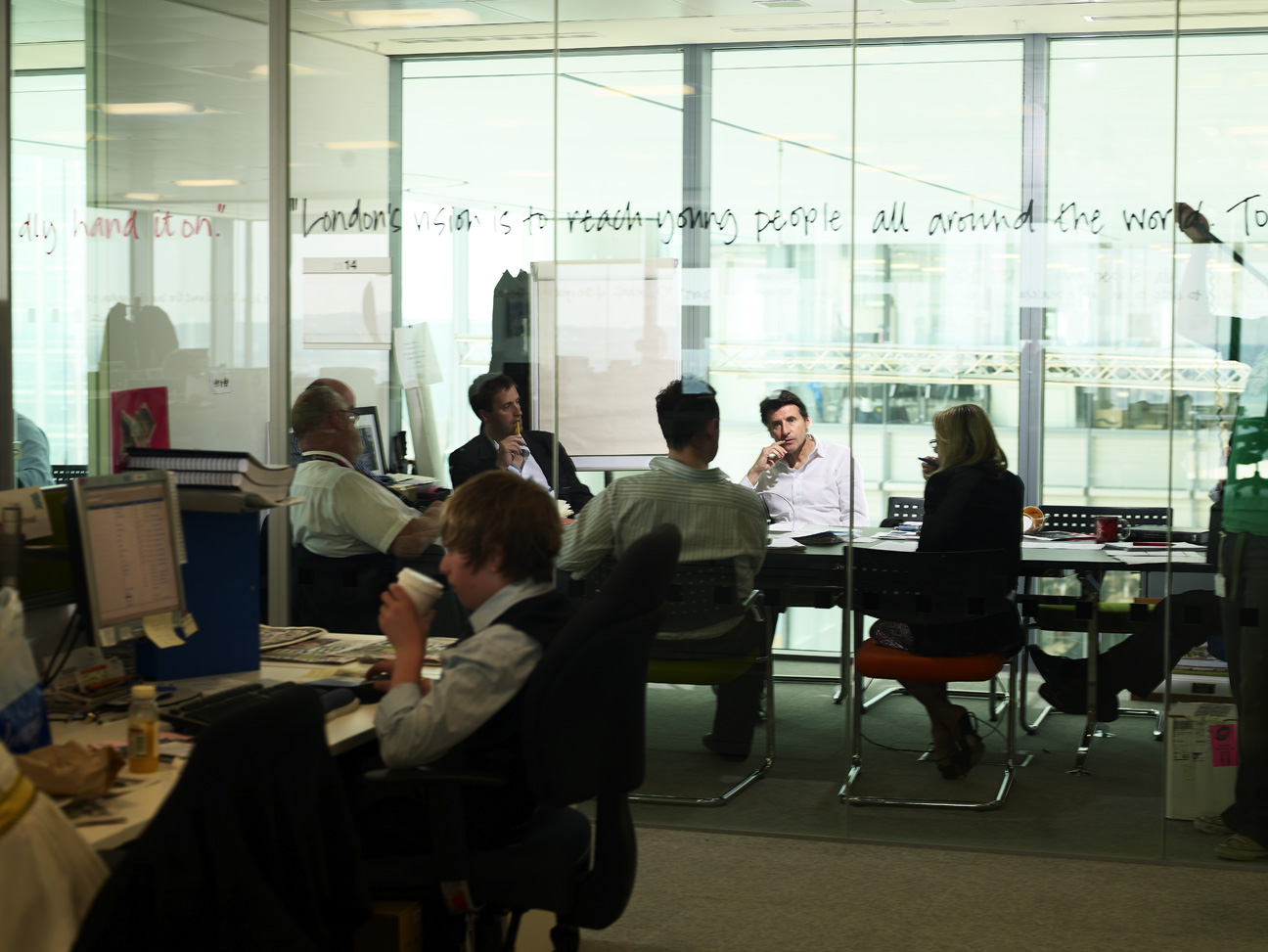
Meeting at LOCOG offices in Canary Wharf

Q & A

Press Conference at The ICA with Mayor of London, Boris Johnson.

Meet & Greet in Gateshead

Meet & Greet in Gateshead
;
;

Train to Newcastle

Competition Winners

Looking towards the stadium

Sebastian Coe, 2008
The Way I Dress: Mr Simon Hammerstein
The third in the new series of films for Mr Porter. Simon Hammerstein is the founder of The Box, which is 2 nightclubs, one in New York and one in London. Hammerstein’s family have had their iron in the showbiz fire from a time when the Dead Sea was still alive. His grandfather, Oscar Hammerstein, along with partner, Richard Rogers, was the man who gave the world such songs as ‘Ol’ Man River’, ‘Oklahoma’, ‘Some Enchanted Evening’, ‘Climb Ev’ry Mountain’ and ‘The Sound Of Music’ among many others.
This film was shot in a suite on the 8th floor of the Standard Hotel in New York City.
The Way I Dress: Mr Matthew Moneypenny
The second in the new series of 5 films for Mr Porter, shot in an apartment in Paris. Matthew Moneypenny is the CEO & President of Trunk Archive, the people who represent the absolute best and greatest in photography that is available for licensing usage. I know photo editors who spend their lunch hour looking at this site because the work they represent is so pleasurable to look at. I would say that though, I’m lucky enough to have my archive represented by them too.
[vimeo http://www.vimeo.com/42199127]Agent Provocateur Classics

My second campaign for Agent Provocateur, a shoot for their 2012 Classics range of underwear, kicked off with a 6am start on a cold, dark February morning at Spring Studios in London. My set was to consist of 20 square metres of charcoal grey silk and a yellow perspex floor. This later became off black in post production but for technical reasons I needed a light floor to reflect some light back onto the model. The AP team built a frame to support it all, at a height off the ground that would allow me to get far enough beneath the models to be able to shoot from the low angle that I wanted to achieve on these.

For inspiration I had been thinking a little bit of Bill Brandt’s work, particularly his beach nudes. I wanted to light these pictures so that there was nothing direct coming from in front of the model. All the lights, 6 in total, heavily softened and diffused, came from behind and were directed towards a long screen of white polyboards in front of the model. I wanted the tone and texture of the skin to take on an alabaster feel which I felt I could only really achieve by bathing the body in purely reflected light. Think of it as being done under the thickest, whitest, blanket cloud imaginable, with only the subtlest kisses of highlight round the edges of the body. This was what I had in my head before we began and, unusually for me, I stuck to it on the day. The second part of the Brandt influence was to take the idea of using quite a wide angle lens and to shoot from extreme low angles, so as to exaggerate the length of the legs. Wide angle lenses are anathema in fashion photography, longer lenses are more flattering to the features and compress the subject so that it’s easier to make everything look softer and more beautified. I liked the idea of going against the grain for Agent Provocateur in this way.

As the crack of dawn showed it’s face outside the studio windows two of my all time favourite collaborators, make up artist Kay Montano and hairdresser Eamonn Hughes, set to work on the blonde Valerie and the brunette Charlotte in their own talented way. Meanwhile, the rest of us sat around and ate carbohydrate products until we were ready to start shooting.


Two wind machines, two laptops and two camera bodies later, we had 19 shots in the bag and a tray of Margheritas to end on. The great thing about working for Agent Provocateur is the attitude and energy that creative director, Sarah Shotton, contributes to the day. She has a brilliant way of ramping up the girls to a level that brings out a great performance. Her red headed presence is the living embodiment of AP, she is the AP girl and can get away with saying things that, coming from my mouth, would just be plain wrong.

To see more of my work for Agent Provocateur please visit my website.
Here’s a montage of behind the scenes shots. Thanks to Nic Serpell-Rand for doing these.

Agent Provocateur Classics Shoot - February 2012
The Way I Dress: Mr Waris Ahluwalia
The first of a new series of 5 films for Mr Porter. This was shot at the Mercer Hotel in New York City in February 2012.
One Hundred And Forty Characters: The Book

One Hundred And Forty Characters: Front/Back Cover and Spine Proof. Designed by Wayne Ford.
This feels like it will never end. While everybody else came to the party, stayed for a drink and left, I have been stuck in the room with all 140 of them for almost a year. It has taken me that long to gather up written pieces from as many of them as I can. Those that didn’t get back to me are too late. I tried, oh I tried. Nevertheless, over 120 people worked their brains to a pulp to give me something insightful, revealing, funny, thoughtful, worrying and optimistic on Twitter, photography, being photographed, 9/11, society, evolution and a thousand other things, as well as collectively creating an impression for future generations of what it means and feels like to be alive today.
The end result is a fantastic 172 page book, featuring written contributions from almost everybody who took part in my 2010/11 quest to photograph 140 of the people I follow on Twitter, as well as the portraits themselves.

One Hundred And Forty Characters: Front/Back Cover and Spine Proof with Blind Emboss Outlines. Designed by Wayne Ford.
In all the talking I’ve done on this project over the last year, time and again I have come back to the role technology plays in making human lives infinitely more convenient, while at the same time conspiring to drive a wedge between us physically. This has been so ever since the invention of the telegraph. The overwhelming response to ‘One Hundred And Forty Characters’ has been positive. The trolls have been contained to an area the size of a trolley and I am convinced that this is because the people who have seen it have innately understood and recognised that deep in our make up we understand that we are pack animals. We need to meet, gather and be together in common cause. OFC is that writ graphically and simply, only made possible because of technology, a lever to allow the conversion of potential energy into kinetic energy.
This has happened in several phases and stages. One, I invited people to my studio via Twitter. Right there they are out of the Twitter window and through my door, in my face. I can see how tall they are, what they sound like, what sort of phone they’ve got, where they came from and on and on. Two, when the project ended there was an exhibition and about 100 of the 140 came to the opening night. This made real a physical manifestation of Twitter’s daily virtual world, where they could all get up in each other’s faces and find out the same stuff I did, but with added alcohol. Finally, all of them are brought together for posterity, into hard copy format, ink on paper, with their thoughts to stand beside them.
“It’s a confessional, a Samaritan, a water cooler and a soapbox all rolled into one.”
– @mostly_grumpy

'One Hundred And Forty Characters' at Foto8 Gallery, London - November 2011
As the years pass and we travel ever further into a world where online relationships will be nothing more than our daily reality, this combination of portraits and words will come to serve as a big old time capsule of what we thought social media was in its earliest days. Oh! how we will look back and laugh at our naiveté, I’m sure.
‘One Hundred And Forty Characters’ is available as a 172 page book, printed in England by F.E. Burman, in a limited edition format, on Fedrigoni Xper 140gsm with a blind embossed cover on Fedrigoni Xper 320gsm. Thank you to Wayne Ford for his beautiful design and art direction and also, Eleanor O’Kane, who proof read every single word and made the necessary corrections to the text.
The book is available directly from here for £35.00 for UK buyers. Click on the first link below:

For buyers from outside the UK the book is £40.00 and you should click here:
Finally, one more treat for you. So you can see just what you’ll be getting for your money, here’s a great little video of the book’s text pages, with a voiceover by me, that took 14 attempts to nail. Lots to look at, lots to read, get yours today. Thirty years from now your kids will be staring at this in wonder thinking, “How did they live like that?”
[vimeo http://www.vimeo.com/40528037]
Guess Who?

I must give the man some kudos here. With most of the people that I photograph it’s a ‘that’ll do’ attitude that carries them through the process. A collaboration is what I’m looking for but, often, what I get is a muted co-operation. Yeah…go on then, just do it quick. I know one Hollywood publicist whose number one criteria when approving photographers for shoots involving his clients is ‘How quick are you?’

Ricky Gervais, photographed for the American edition of Mens Health on 5th December 2011.
I have photographed Ricky Gervais 5 times and, unlike most, he gives much more. He can be tentative initially, a little wary, but once he has committed to an idea he’s up for it in all it’s forms.
I once photographed him for a Christmas related story, in the middle of July, which involved a terrible sweater and Kermit the Frog. We were trying to make it look like Ricky & Kermit were sharing a laugh together in an old skool Christmas Radio Times kind of way. We shot hundreds of frames and were really struggling with it. He persisted with the inanimate frog for much longer than one would have expected until, at last, he decared, “Wait! I’ve got it, I’ve got it! Whattabout like this?……”

The second time I photographed him was at the Dorchester Hotel in London. I was told I had 3 minutes and when he came in he acknowledged how little time we had been given, so offered to do whatever he could to make it work. I said I was going to recite a list of 1970’s sitcom actors and would photograph his reaction on hearing the name of each one. Number 8 was ‘On The Buses’ star Reg Varney, who I think looks like Gervais in a sort of lackadaisical 1970’s way. Evidently, Reg’s name had it’s own effect on him because it yielded this reaction…

This time we were doing a shoot to illustrate his recent heavy weight loss, brought on by boxing and running. It needed some energy and he really did bring it. He battered that punchball for as long as I exhorted him to keep at it and after each kick he would come to the computer, examine it carefully and then insist on giving it another go until he felt the image looked right. Here’s what we got…..


The Badge Of A Wifebeater
This is as heavy as any piece of armour worn at Agincourt. Created by Fee Doran of Mrs Jones in London. Among her other creations was a pair of trousers made for Justin Hawkins of The Darkness. The unique thing about those was that they were made entirely from pairs of knickers thrown at him onstage by female fans. Tasty.


Remembrance Of Things Past: Elizabeth Jagger & Bodybuilder, 2002.

Elizabeth Jagger & Bodybuilder 1. New York City, 2002
I have been digitizsing a lot of my archive in the last year. Well, I say ‘a lot’ but really I’ve bagged up maybe 5%, something like that. I worked on film for 16 years before I switched to digital photography, so I dread to think what it would be like for someone 30 years older than me whose entire career is on film. When I contemplate the magnitude of the task, I close my eyes and picture myself standing there, all little, with a dull eyed Charlie Brown look of puzzlement, anxiety and fear on my face. In this imagined tableau, there is, in front of me, the most enormous fucking mountain you’ve ever seen. Far bigger than Everest. In this scenario Everest would fit on to a cereal box.
However, to alleviate this fear of the big task, I should spend more time reminding myself about the forgotten work I trip over and re-discover every time I submit myself to the process. I’m not afraid to admit this but I’m getting to the point where I enjoy the process of looking back as equally as I do the process of looking forward. I suppose it could be considered the opposite of a midlife crisis, in that I have reached a point where I’ve grown into myself and have come to accept what I am with magnanimity and gratitude. I know what my faults are and I know what my strengths are. I know how to deploy one in the suppression of the other. Looking at old work causes me to confront the mistakes I made in arriving at this juncture. After all, wisdom is, I believe, nothing more than the accumulative lessons learned from a lifetime of mistakes.

Elizabeth Jagger & Bodybuilder 2. New York City, 2002
This series of fashion portraits of Elizabeth Jagger I was commissioned to do in 2002 by Steven Baillie for Surface Magazine is a good example of the simple pleasure to be had from rummaging around in the crates of my past. I had utterly forgotten that I had done them until I found a set of 11″x14″ black & white selenium toned fibre prints in a box in the storage unit where I keep it all. The storage unit is a 24 hour, remote access kind of place. It’s cold, it’s desolately eerie and I don’t like going there. There’s always something banging and clanging out of sight. I worry that bad stuff could happen.
Of course as soon as I had spent a few minutes rediscovering the pictures it began to meander back. Milk, the big New York studio, gave me one of their spaces for virtually nothing. There was a casting call for a very old school type of bodybuilder. We really wanted a pre-steroids era kind of guy. I had just bought an iPod, they had only been around for a few months. It was set to random shuffle. Early in the day it threw up ‘Miss You’ by The Rolling Stones. I remember being mortifyingly embarrassed in the presence of the daughter of a Rolling Stone.
As for what I said earlier about confronting the mistakes of the past in the endeavour to build a better future, I’m slightly embarrassed to say that, looking at these images now, there is nothing about them that I would have done differently. There is nothing they can teach me. I just like looking at them, I’m not ashamed of them. Writing about them here is an indulgence. But that’s ok, there’s loads of other crap in my rear view mirror that I can learn from. But it can also be said that it’s possible to turn a good career into a great career merely by employing the services of a brilliant editor.
I searched for all the negatives from the shoot but I couldn’t find them. Maybe they got lost when I moved back to London from New York in 2006. Is that bad? Or does it make me value these 3 perfectly flat and preserved fibre prints even more? I like to think that it really does.

Elizabeth Jagger & Bodybuilder 3. New York City, 2002
 Chris Floyd: Clean Living Under Difficult Circumstances.
1 comment